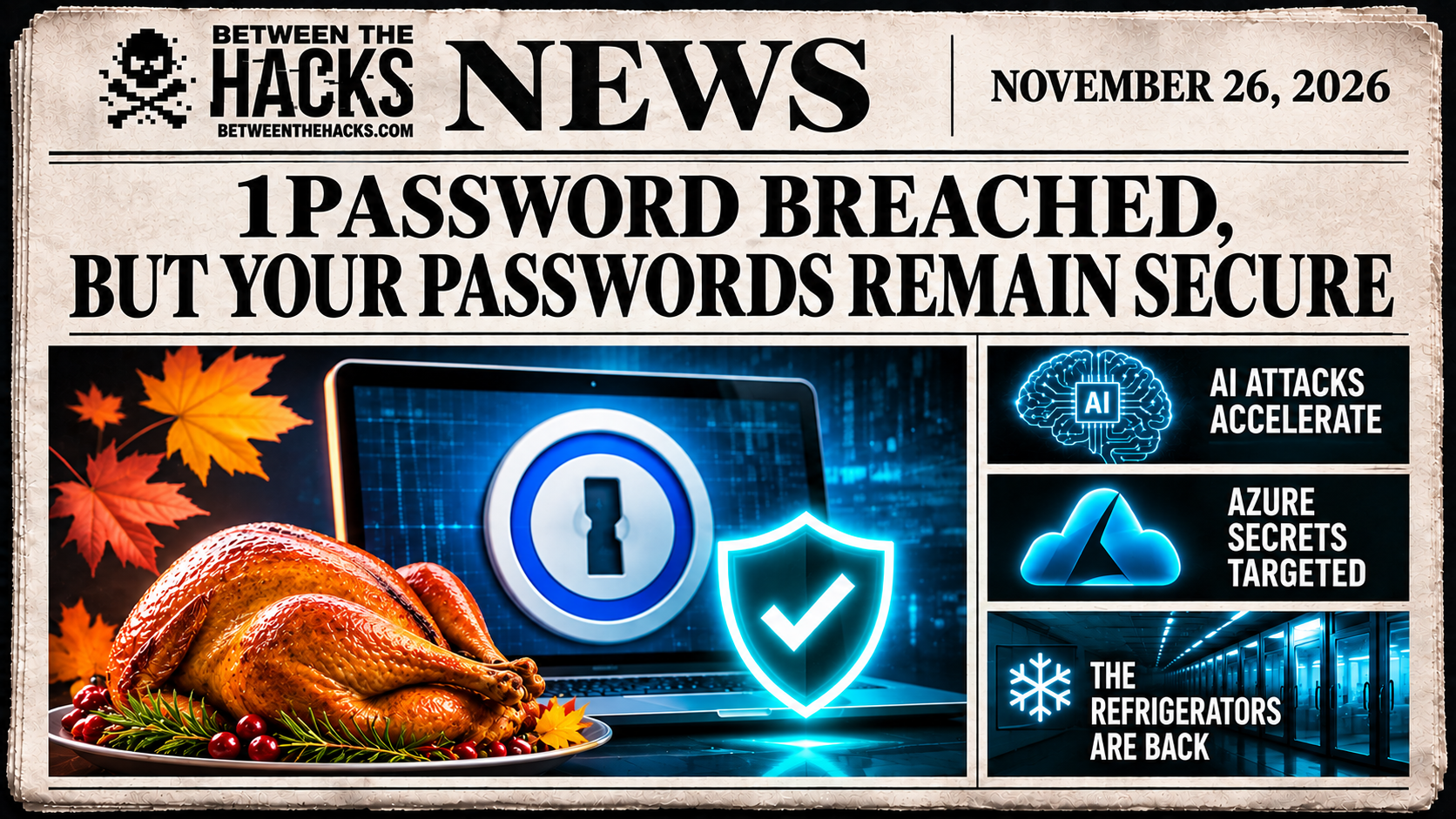
BTH News: 1Password Breached, AI Attacks Accelerate, and the Refrigerators Are Back
November 26, 2026
Happy Thanksgiving to our readers celebrating in the US, and a special thanks to the cybersecurity and IT professionals working today so others can enjoy the holiday.
This week in Between The Hacks, attackers broke into a password manager's systems without getting customers' passwords, AI agents discovered and exploited vulnerabilities on their own, and attackers targeted credentials stored in a Microsoft cloud service.
And just when we thought we were done talking about refrigerators...
1Password was breached. What about your passwords?
On Wednesday, 1Password disclosed a security breach involving some of its backend systems. An attacker gained access to an employee's corporate GitHub account, accessed source code and deployed malicious code to backend services.
According to 1Password, the attacker obtained account information belonging to a subset of its customers, including names, email addresses, account metadata and certain tokens associated with account invitations, provisioning and recovery.
What the attacker didn't get is arguably more interesting. According to 1Password, customer vaults, stored passwords, Secret Keys and the cryptographic keys protecting those vaults were not compromised.
This is an important distinction and a good example of why security architecture matters. We can't guarantee that a company will never suffer a breach, but we can design systems that limit what an attacker can access when one occurs.
1Password's architecture is designed so that the company itself cannot access customers' vault contents.
That's a security feature that matters considerably more this week than it did last week.
1Password says customers do not need to change anything in their accounts. However, customers should be particularly cautious of unexpected emails, invitations and account recovery requests. Criminals may use news of the breach to launch convincing phishing attacks.
If you're a 1Password customer, this is not a reason to abandon your password manager.
Cyberattacks are moving at machine speed
Last Friday, Amazon published research describing how attackers used an autonomous AI framework called Cairn to target universities in East Asia.
What makes this investigation particularly interesting is that the AI agents discovered and exploited a previously unknown vulnerability in a medical imaging application.
This wasn't a controlled experiment conducted by security researchers. It was an actual cyberattack.
Then, on Wednesday, Microsoft published its own investigation into another AI-powered security testing framework called ARTEX.
Microsoft has observed both financially motivated criminals and state-sponsored threat actors using the framework to automate attacks. In one attack Microsoft observed, an AI agent went from searching GitHub for exposed credentials to stealing data from Azure Key Vault in just five minutes.
Most of the techniques Microsoft observed aren't new. What's changing is the speed, scale and level of human involvement required to execute them.
Earlier this year, I wrote about AI's ability to discover previously unknown vulnerabilities in The Mythos Discovery. We're now seeing how attackers can put similar capabilities to work.
Our vulnerability management and incident response processes were largely designed around the speed at which humans operate.
Our adversaries are becoming considerably less constrained by that speed.
Attackers target secrets stored in Microsoft Azure
Norway's National Security Authority warned that attackers have been exploiting a vulnerability in Microsoft Azure API Management, a cloud service that helps organizations manage and control access to applications and services.
Attackers targeted access tokens and other authentication secrets that could potentially provide access to additional systems and sensitive information.
Several Norwegian organizations were affected, including companies in the energy sector.
Although the vulnerability has reportedly been fixed, Norwegian authorities are recommending that organizations using the affected service assume their stored secrets may have been compromised and replace them.
Think of it like replacing the lock on a door after someone has stolen the keys to other doors in the building.
Fixing the original vulnerability doesn't invalidate credentials that may already have been stolen.
The refrigerators are back
Regular BTH readers may remember our recent coverage of cyberattacks against commercial refrigeration systems across Europe.
This week, CISA published an advisory about another critical vulnerability in Danfoss commercial refrigeration controllers.
The vulnerability, CVE-2026-129713, affects certain Danfoss AK-SM 800A series controllers and could allow an attacker with network access to the affected web interface to execute malicious code with web server privileges, without authenticating.
A firmware fix was not available at the time of disclosure.
There is no confirmed link between this particular vulnerability and the previously reported attacks.
Still, the recommendation remains the same. Commercial refrigeration controllers should not be directly accessible from the Internet. Organizations that need remote access should use an appropriately secured solution.
A refrigerator doesn't need to be accessible to everyone on the Internet to keep your Thanksgiving leftovers cold.
Your router's cloud service became the way in
GL.iNet, a manufacturer of popular home and travel routers, disclosed a security incident involving its GoodCloud remote management service.
Attackers exploited a vulnerability in the cloud service and installed malware on some customers' routers and remote computer management devices.
GL.iNet says it has closed the identified attack path. However, devices that were already compromised require remediation.
This is another example of a concept I recently discussed in Internet-Connected Doesn't Mean Internet-Accessible.
A device doesn't necessarily need to be directly exposed to the Internet for an attacker to reach it. A compromised cloud management service can provide another path.
If you own GL.iNet equipment, review the manufacturer's security advisory and install the latest security firmware for your model. If you suspect your device was compromised, follow the additional recovery and credential-change recommendations.
Installing an update can't undo previous unauthorized access.
Between the Hacks
There's an interesting contrast in this week's stories.
1Password suffered a breach, but according to the company, its security architecture helped protect its customers' most sensitive information. Meanwhile, compromised cloud services provided attackers with paths to other systems, and AI agents demonstrated how quickly those paths can be discovered and exploited.
Preventing every breach isn't a realistic security strategy. Limiting what an attacker can access when a breach occurs is.
Have a safe and happy Thanksgiving.